What is sedation dentistry?
Sedation is a technique of using medications to increase a patient's cooperation, reduce anxiety, and control discomfort during dental procedures. Sedation is described on a continuum: mild, moderate, deep, and general anesthesia. Dr. Colleen will evaluate your child's dental needs, health history, and cooperation to determine the appropriate sedation level for your child.
Are there different levels of sedation?
Yes, we offer nitrous oxide, oral moderate sedation, and general anesthesia sedation options.
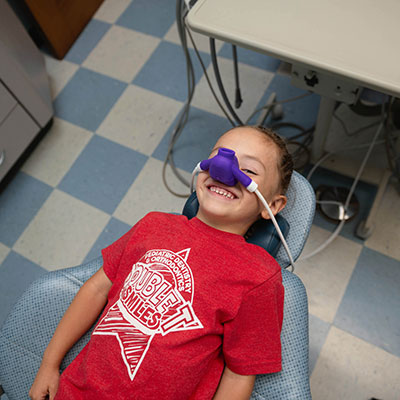
Nitrous oxide (N2O) is a safe and effective inhaled anesthetic/gas that can reduce anxiety in a patient and offer a low level of pain relief. It has a very rapid onset and offset, making it possible to return to normal activities following a dental procedure. Nitrous oxide is a great option for cooperative patients needing lengthy treatment appointments or those with mild to moderate dental anxiety.
Oral moderate sedation is a technique that combines oral anxiolytic/sedation medications and nitrous oxide. It is intended to make a patient drowsy and relaxed. This is an effective sedation option for children or adolescents who are very anxious or require more extensive treatment and are somewhat cooperative. A patient will need to fast prior to an oral moderate sedation and have arrangements to spend the remainder of their day resting at home.
General anesthesia is a sedation technique that produces a state of unconsciousness. This eliminates patient movement, discomfort, and awareness, allowing for the delivery of high-quality and safe dental care. General anesthesia may be administered in-office or in a hospital setting by a qualified anesthesiologist. The anesthesiologist first uses anesthetic gases to help your child fall asleep, and then delivers medications through an IV. This sedation method is indicated for patients who are unable to cooperate due to young age or extreme anxiety, have complex medical conditions, or have extensive treatment needs. As with a moderate level of sedation, the patient will need to fast prior to the procedure and have arrangements to spend the remainder of their day resting at home.
What is sedation dentistry is most helpful for?
- Young children
- Patients who require extensive treatment
- A very anxious child
- Children who have had traumatic dental experiences
- Patients with sensory issues who do not tolerate well certain tastes, smells, or sounds
- Patients with a strong gag reflex
- Patients who are medically compromised or developmentally delayed
Pain Control
Dr. Colleen makes every effort to administer local anesthetics in a slow, gentle, and comfortable manner, thus minimzing any pain that may accompany dental treatment. Adequate pain control during a procedure is paramount to ensure the patient accomplishes the treatment successfully. Please be aware that we do not use the words "shot" or "needle" at Double T Smiles. We choose another term for an injection: "bubble"! Euphemisms allow us to relate to the kids in a more positive way and build a rapport.
The duration of numbness after treatment varies from patient to patient and depends on which anesthetic was used. In general, the numbness wears off in two to four hours. During this time, parents must monitor their child closely to ensure they do not chew, bite, or suck on their lip, cheek, or tongue. This can lead to injury of the soft tissue. Offering your child cold beverages, smoothies, or popsicles while they are numb can be a great distractor!